9 Top Cloud PACS Platforms for Vendor-Neutral Archiving (VNA)
Your PACS works fine until it stops talking to your new scanner or your old archive. Many platforms lock images into proprietary formats, so switching vendors means migration headaches and duplicate storage costs. That friction is usually what sends imaging teams hunting for a vendor-neutral archive.
This article breaks down what to check before you commit: DICOM conformance, migration tooling, interoperability, deployment, security, and pricing. Then it compares nine cloud PACS platforms for VNA, from Medicai to Mach7, so you can shortlist a clear winner.
What to Look For in Cloud PACS Platforms for Vendor-Neutral Archiving
Selecting a cloud PACS for vendor-neutral archiving requires evaluating capabilities that ensure seamless data exchange and long-term accessibility across diverse clinical systems. A vendor-neutral archive sits at the center of enterprise imaging, so the platform you choose must outlast individual modality vendors, departmental PACS, and even the radiology department itself.
Three evaluation areas matter most. First, standards compliance, since DICOM, HL7, and FHIR determine whether images and metadata move cleanly between systems. Second, migration and lifecycle tools, because most organizations are consolidating several legacy archives rather than starting fresh. Third, deployment, security, and pricing, which shape total cost of ownership over a decade or more.
Interoperability deserves special attention during evaluation. A VNA that stores images but cannot reconcile patient identities across facilities creates new silos instead of removing old ones. Ask vendors how their platform handles master patient index matching, study reconciliation, and cross-enterprise sharing.
The subsections below break these factors into practical checklists. Use them to build a scoring framework before vendor demonstrations begin, so comparisons stay grounded in requirements rather than presentation quality.
Key VNA Capabilities: DICOM Standards, Migration Tools, and Interoperability
A robust VNA must support DICOM standards, offer comprehensive migration tools, and facilitate interoperability with HL7 and FHIR to work together with electronic health records. These three capabilities form the technical backbone of any vendor-neutral archive.
DICOM compliance covers far more than basic image storage. Look for support for DICOM query and retrieve, storage commitment, and modality worklist so the archive behaves like a native PACS to imaging equipment. Support for compressed transfer syntaxes and image compression also affects cloud storage costs and retrieval speed, particularly for large studies such as mammography or cardiac imaging.
Migration tools determine how quickly you can retire legacy systems. Evaluate whether the platform can ingest data from older PACS, handle non-DICOM objects, and reconcile duplicate patient records during the move. A phased migration with validation reports is usually safer than a single cutover.
Interoperability extends the archive beyond radiology. HL7 and FHIR support lets the VNA exchange patient context with electronic health records, while API integration enables reporting systems, AI in radiology tools, and teleradiology platforms to query images directly.
- DICOM storage, query and retrieve, and storage commitment
- HL7 and FHIR interfaces for EHR integration
- Migration utilities for legacy PACS and non-DICOM content
- APIs for viewers, reporting, and machine learning pipelines
Together, these capabilities produce a unified patient record and prevent the data silos that vendor-specific archives tend to create.
Deployment, Security, and Pricing Considerations
When evaluating cloud PACS, consider deployment models, security measures like HIPAA compliance and encryption, and pricing structures that align with your organization's scale and budget. These factors often decide whether a technically strong platform is actually sustainable.
Deployment generally falls into fully cloud and hybrid models. A full SaaS deployment reduces on-premises infrastructure and simplifies disaster recovery, while hybrid designs keep some data local for latency or policy reasons. Either way, confirm that the architecture supports scalability and redundancy across regions.
Security requirements include encryption at rest and in transit, role-based access control, and audit trails that record every image access. HIPAA compliance is the baseline for US organizations, and many platforms also pursue certifications such as SOC 2. Ask how audit logs are retained and whether they can be exported for internal review.
Pricing models vary widely. Common structures include subscription fees per user or per study, tiered storage pricing that moves older studies to lower-cost object storage, and separate charges for migration or API usage. A low entry price can hide rising retrieval or egress costs.
To assess total cost of ownership, model five to ten years of storage growth, migration effort, and data retention requirements. Include the cost of retiring legacy systems and the staff time needed to manage lifecycle policies. A platform that is transparent about these numbers is easier to justify to finance and easier to operate over time.
1. Medicai - Best Overall
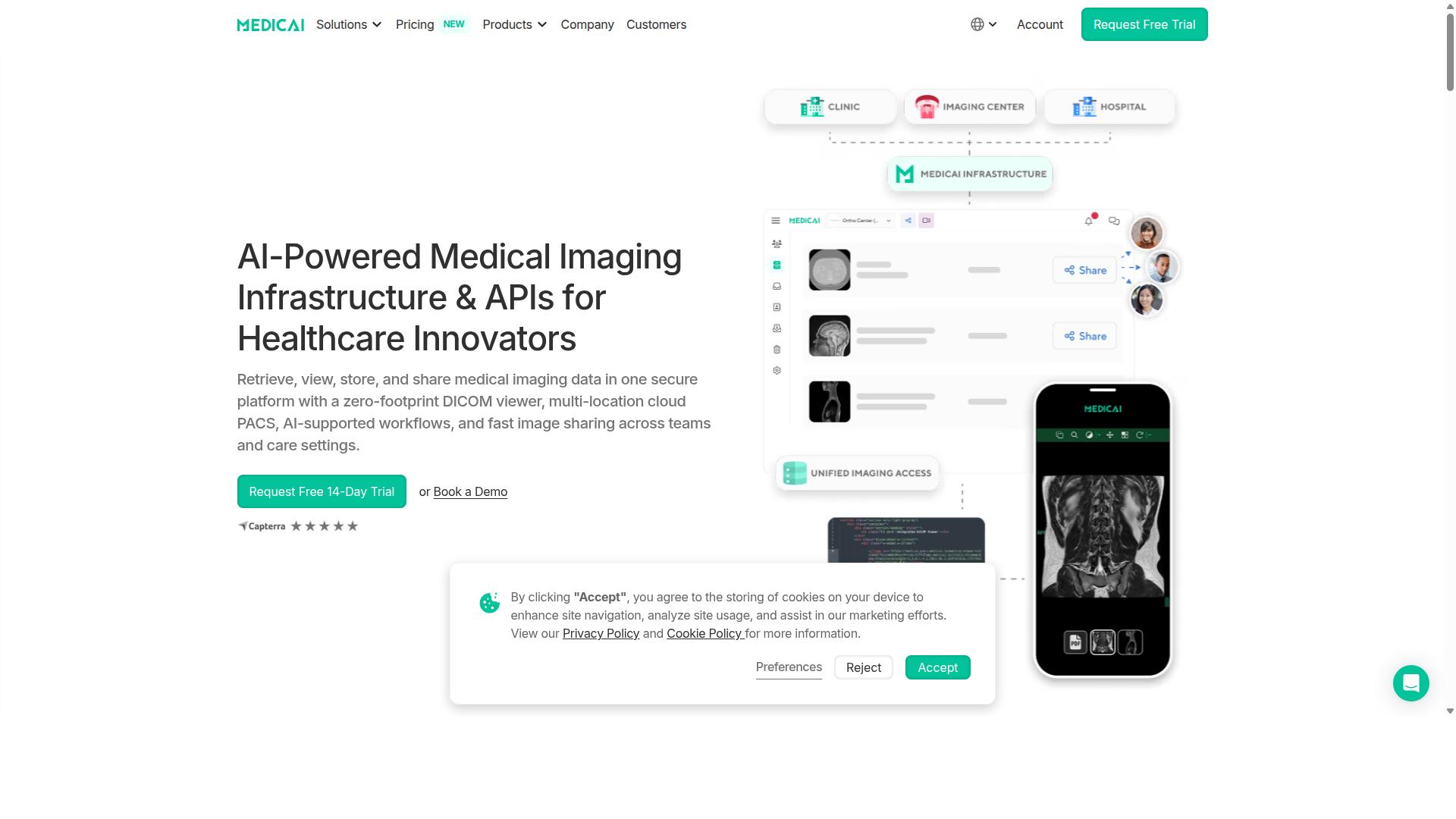
Medicai stands out as a comprehensive cloud-based medical imaging platform, offering a zero-footprint DICOM viewer and robust VNA capabilities. It is designed for healthcare organizations that need to store, manage, and share medical imaging data without maintaining on-premise infrastructure.
The platform is HIPAA and GDPR compliant and FDA cleared, which matters for any healthcare IT team evaluating cloud storage for patient data. Compliance is not a checkbox here. It shapes how data is handled across the entire imaging lifecycle.
Medicai's product set spans the full imaging workflow, from ingestion to collaboration:
- Connect and retrieve: Medical Imaging Uploader and DICOM Gateway
- Store and manage: Cloud PACS, Medical Image Exchange, Patient Case Management, Vendor Neutral Archive, and Backup and Disaster Recovery
- Access, visualize, and collaborate: Structured Reporting for Radiology, Doctor Imaging Portal, Patient Imaging Portal, DICOM Viewer, Medicai Imaging API, and Mobile Imaging App
- Advanced capabilities: Radiology AI Co-Pilot, AI-Powered Diagnostics, Teleradiology, Medical Image Sharing Platform, and Tumor Boards support
The combination of a Vendor-Neutral Archive with a zero-footprint viewer means radiologists and referring physicians can access diagnostic imaging through a browser, without workstation installs. For teleradiology and multi-site practices, that reduces friction in the clinical workflow.
Scalability and global availability round out the offering. Because Medicai is delivered as SaaS, organizations can grow their image archiving footprint without provisioning new hardware. Data migration, interoperability, and lifecycle management are handled within the same platform.
For teams weighing cloud PACS options, Medicai's breadth is its clearest differentiator. Rather than stitching together a PACS, a separate VNA, and third-party reporting tools, healthcare IT can consolidate around one platform that covers image archiving, diagnostic imaging, and AI in radiology.
2. Intelerad

Intelerad offers enterprise imaging solutions with a focus on radiology and interoperability, catering to large healthcare networks. The company is best known for its image exchange and enterprise imaging platforms, which are built to help hospitals and health systems unify imaging records across multiple departments and locations.
Its platforms support DICOM workloads and are designed to work together with vendor-neutral archives. That combination matters for organizations that want to keep a single, accessible view of imaging data while still relying on a VNA as the long-term storage backbone.
Intelerad's enterprise image exchange tools enable secure sharing and access of medical imaging across healthcare networks. This kind of cross-network access is often useful for referral relationships, multi-site health systems, and teleradiology workflows where images need to move between facilities quickly.
The platform is positioned for hospitals and large health systems seeking to unify radiology, cardiology, pathology, and point-of-care imaging records. That multi-specialty scope reflects a broader shift in healthcare IT, where enterprise imaging is no longer limited to diagnostic radiology alone.
- Interoperability: supports DICOM and integrates with vendor-neutral archives
- Enterprise imaging: designed to bring radiology, cardiology, pathology, and point-of-care records together
- Image exchange: enables secure sharing across healthcare networks
- Target users: hospitals and large health systems
No pricing information is publicly stated on the pages reviewed, so organizations comparing cloud PACS and VNA options should request a quote directly. As with any enterprise imaging platform, buyers should also confirm how the system handles HL7 and FHIR interfaces, data migration from legacy PACS, and lifecycle management for long-term image archiving.
For healthcare networks weighing cloud PACS against a standalone Vendor-Neutral Archive, Intelerad is typically considered when cross-enterprise image sharing and multi-specialty unification are priorities. Its fit depends on existing infrastructure, department mix, and how much of the imaging record already lives in a VNA.
3. Sectra
Sectra provides medical imaging IT solutions, including cloud PACS and VNA, known for their focus on radiology and enterprise imaging. The company's portfolio is built around clinical depth rather than breadth alone, with tools that span reading, reporting, and long-term image archiving.
Sectra Medical offers a suite that includes Sectra One Cloud, Sectra IDS7, Sectra UniView, Sectra VNA, Sectra Reporting, Sectra Amplifier Services, and Sectra Image Exchange Portal. Together, these products cover the workflow from acquisition to diagnosis to archive.
The platform is not limited to radiology. Sectra's solutions also address breast imaging, cardiology, digital pathology, orthopaedics, genomics, ophthalmology, and medical education. That range matters for organizations pursuing a single enterprise imaging strategy across departments.
Sectra's VNA fits the vendor-neutral archive model by consolidating imaging data from multiple sources into one managed environment. Interoperability with standards such as DICOM and HL7 supports integration with existing PACS, modalities, and clinical systems. A modular design lets healthcare IT teams adopt components in phases rather than replacing everything at once.
Security and access control are central to enterprise imaging, particularly for HIPAA compliance and audit trail requirements. Sectra's solutions are positioned for organizations that need governance over sensitive medical data across a distributed user base.
Adoption is broad. More than 2,500 sites worldwide use Sectra systems, and Sectra PACS has ranked #1 in customer satisfaction in Best in KLAS for 13 consecutive years. Those figures reflect sustained performance in radiology and diagnostic imaging rather than a single strong product cycle.
For buyers evaluating cloud PACS and VNA options, Sectra is worth shortlisting when clinical imaging depth, cross-specialty coverage, and a long track record in customer satisfaction are priorities. Pricing is not published on its public pages, so budget discussions typically require a direct conversation with the vendor.
4. Agfa HealthCare Enterprise Imaging
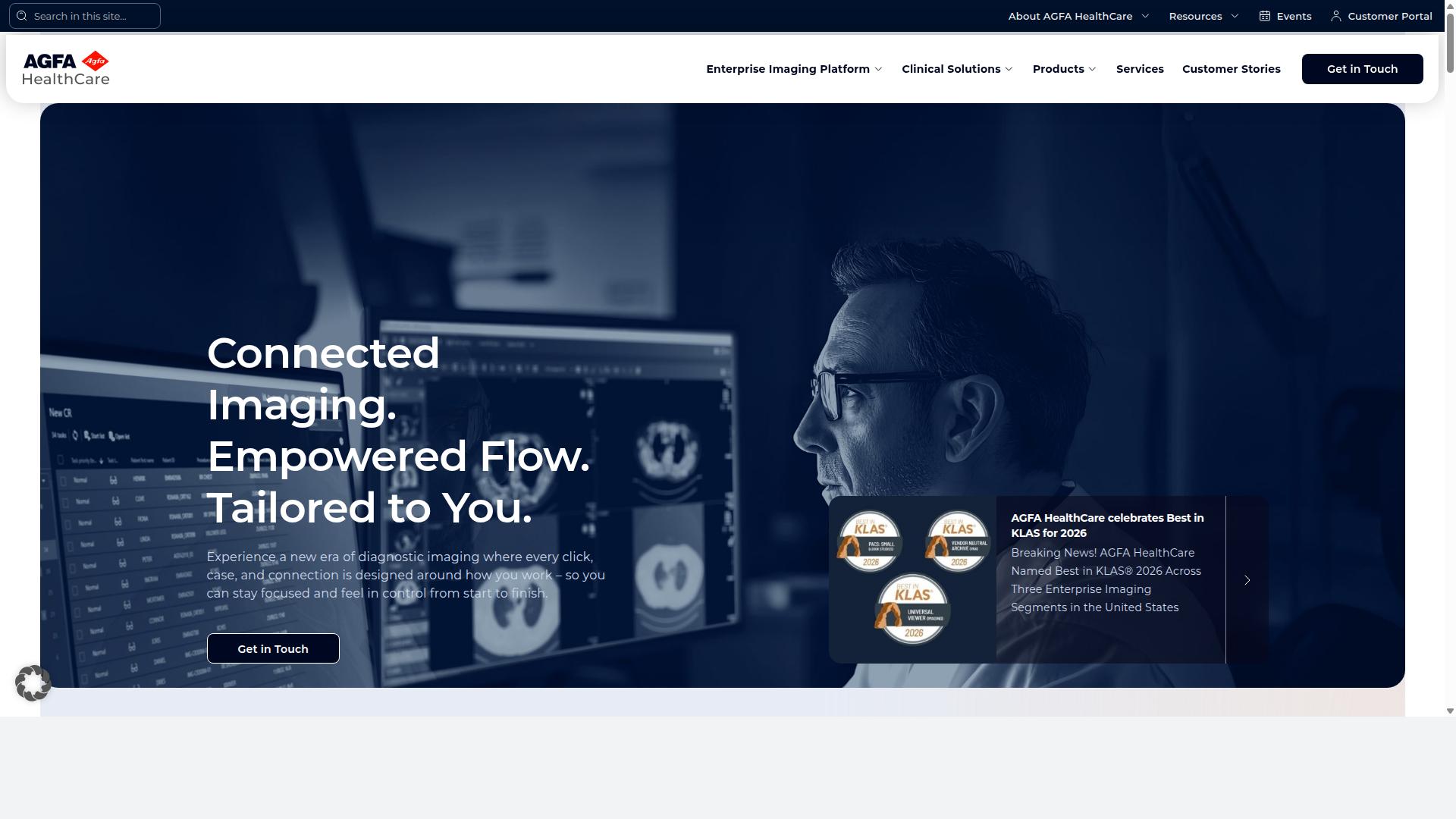
Agfa HealthCare's Enterprise Imaging platform includes VNA and cloud PACS components, designed for comprehensive clinical workflows. It is a modular system that consolidates medical images into a single patient imaging record, helping organizations close the image gap in the electronic health record (EHR).
For healthcare IT teams evaluating vendor-neutral archiving options, Agfa represents an established enterprise imaging vendor with a broad clinical footprint. The platform's structure leans toward large hospitals and health systems that need to standardize imaging across multiple departments and specialties.
Core platform components include enterprise viewing, image capture, storage, and a vendor-neutral archive. A secure portal rounds out the offering, giving clinicians and patients controlled access to imaging data. Together, these modules support the full imaging lifecycle from acquisition through long-term archiving.
The VNA component is central to Agfa's value proposition. By acting as a neutral repository, it allows imaging data from disparate PACS, modalities, and departments to live in one accessible location. This reduces fragmentation and supports data migration efforts when legacy systems are retired.
Clinical breadth is a notable strength. The platform supports radiology, cardiology, orthopedics, dermatology, ophthalmology, and nursing, which makes it relevant for organizations seeking a single imaging record across service lines rather than isolated departmental silos.
Several features target day-to-day clinical workflow:
- Visual online collaboration, including chat and image sharing between clinicians
- Structured reporting to standardize diagnostic documentation
- Critical findings flagging to surface urgent results for timely follow-up
These tools matter for teleradiology and multi-site reading groups, where fast communication between radiologists and referring physicians affects turnaround. Structured reporting also supports downstream analytics and data management efforts.
Deployment flexibility is another consideration. Agfa HealthCare can host the platform as a SaaS offering with predictable, all-inclusive service costs, or organizations can deploy it on-premises. That range suits enterprises with varying cloud strategies and data residency requirements.
Standards support underpins interoperability across the platform. Buyers evaluating any cloud PACS or VNA should confirm DICOM handling, HL7 and FHIR integration, and how the system fits existing healthcare IT infrastructure. Agfa's positioning targets hospitals and enterprises seeking cost savings, clinical efficiency, and standardization.
When comparing options, weigh how each platform handles data retention, lifecycle management, and tiered storage, since imaging archives grow continuously. Access control, encryption, and audit trail capabilities are equally important for HIPAA compliance and security reviews.
Agfa HealthCare Enterprise Imaging fits organizations that want a modular, multi-specialty platform with both cloud and on-premises paths. Its combination of VNA, enterprise viewing, and clinical collaboration tools makes it a credible contender in the vendor-neutral archiving space, particularly for large health systems pursuing consolidation.
5. Ambra Health
Ambra Health offers a cloud-based medical image management platform with VNA capabilities, emphasizing image exchange and interoperability. Now part of Intelerad, the platform serves radiology practices, hospitals, health systems, cardiology groups, life sciences teams, and research organizations.
Its core strength is moving images between places they need to be. Clinicians can store, upload, view, and share studies across multiple sites and EHR systems without worrying about which PACS originally captured the exam.
For healthcare IT teams evaluating cloud PACS and Vendor-Neutral Archive options, Ambra Health is typically considered when cross-site image exchange matters as much as long-term archiving. It fits multi-location networks and academic or research settings where outside collaborators need controlled access to studies.
Key capabilities commonly associated with the platform include:
- Secure storage and exchange of DICOM and non-DICOM files, including JPEG, DOC, and TIFF
- Role-based access control for staff, partners, and referring physicians
- Web-based diagnostic viewing with annotations and measurements
- Data anonymization tools for research and teaching use cases
- Remote collaboration features for distributed care teams
Pricing is custom, so organizations should request a quote based on study volume and user count. As with any VNA evaluation, confirm how the platform handles data migration, retention policies, and integration with existing radiology workflows before committing.
Ambra Health tends to appeal to teams that prioritize interoperability and image sharing over deep on-premises infrastructure. It is a credible option in the cloud PACS landscape, particularly for organizations juggling images from many sources and systems.
6. Dicom Systems Unifier Platform
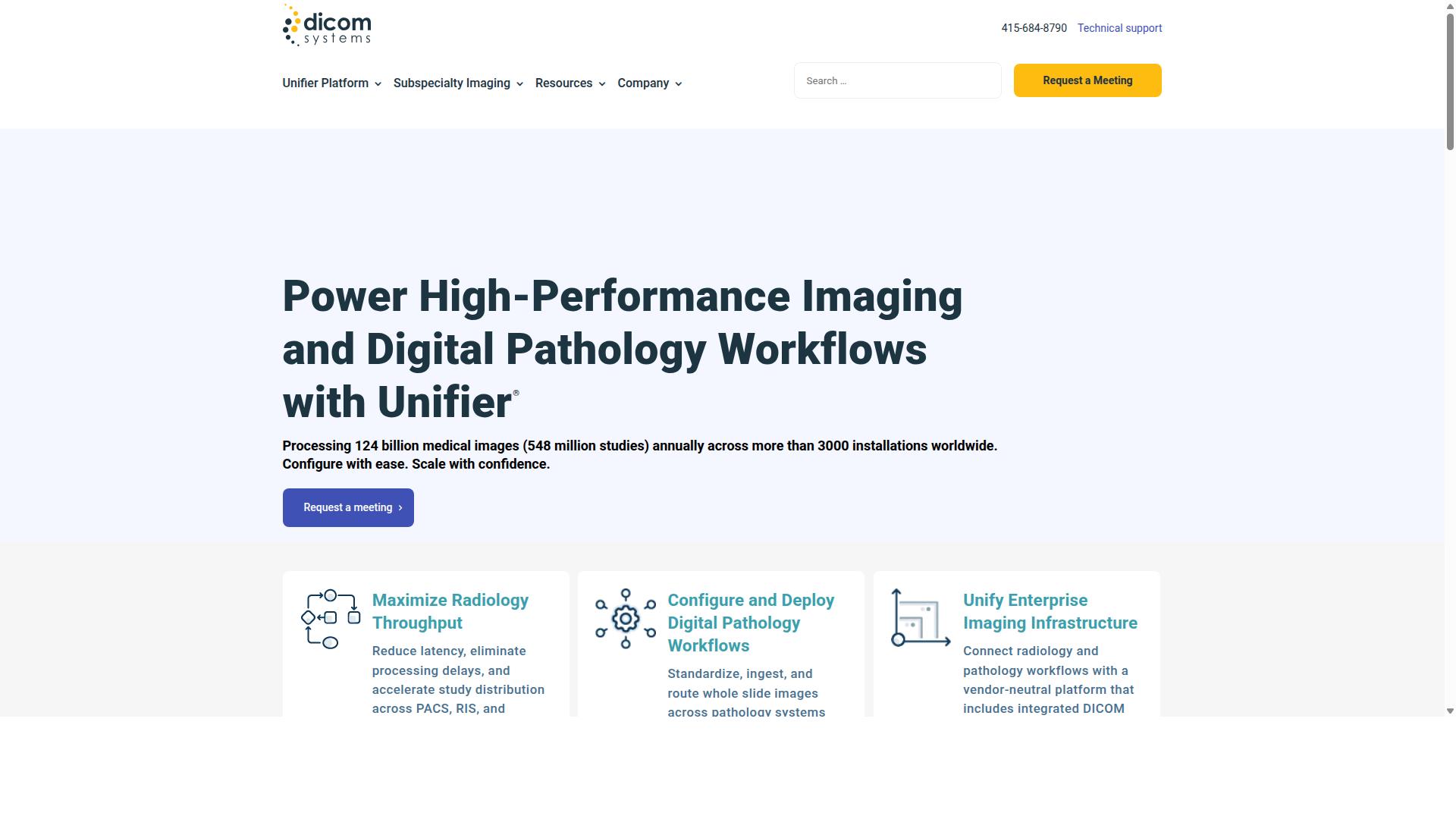
Dicom Systems' Unifier Platform provides VNA and cloud PACS solutions, focusing on DICOM routing and interoperability. It is generally positioned as an enterprise imaging tool that helps healthcare organizations connect disparate systems and move studies between them.
The platform is commonly listed among PACS software options and holds a 5.0 overall rating from 22 reviews on public software directories. Those listings place it alongside other imaging vendors, though they do not detail its specific feature set, pricing, or target users.
Unifier is typically associated with DICOM routing and interoperability rather than a single-department PACS. That focus matters for vendor-neutral archiving, where the goal is to consolidate images from many sources into one accessible layer.
Typical use cases for a platform like this include:
- Routing studies between modalities, PACS, and archive systems
- Connecting imaging sources that use different vendors or formats
- Supporting migration and consolidation projects across sites
- Feeding images into cloud or on-premise storage tiers
Because public sources do not describe its features or pricing in detail, buyers should confirm specifics directly. Ask about supported standards such as DICOM, HL7, and FHIR, viewer options, and how the platform handles retention and lifecycle management.
For radiology and healthcare IT teams evaluating a VNA, the key question is fit. A routing-focused platform can serve as a strong interoperability layer, but it should be assessed against your image archiving, cloud storage, and clinical workflow needs.
7. Fujifilm Synapse
Fujifilm's Synapse is a medical imaging platform that includes cloud PACS and VNA functionalities, widely used in radiology. It sits within a broader enterprise imaging portfolio that also covers cardiovascular, 3D, RIS, and cloud services.
For healthcare IT teams comparing vendor-neutral archiving options, Synapse is often evaluated as an established enterprise-grade system rather than a lightweight viewer. Its reach across radiology and specialty departments makes it relevant to organizations planning long-term image archiving strategies.
Synapse VNA and Enterprise Viewer are typically positioned alongside the core PACS, which can simplify how a health system consolidates imaging data from multiple sources. The platform also supports a universal diagnostic viewer and fast case loading for radiologists working through high-volume reading lists.
Version 5 introduced a server-side rendering architecture, which shifts processing to the server and can reduce demands on client workstations. Publicly described benefits include sub-second on-demand access to large datasets, a zero-download viewer with browser flexibility, and various IT advantages tied to that architecture.
Integration is a central part of the Synapse story. Documented EHR connections include Epic and Oracle Health EHR (Cerner), which matters for organizations that need imaging to flow into existing clinical workflows rather than sit in a separate silo.
Other commonly cited capabilities include server-side rules with AI and algorithm execution, analytics, and active monitoring. These features support clinical workflow efficiency and give imaging leaders visibility into system performance.
When assessing Synapse for a VNA initiative, practical questions include how it handles DICOM and HL7 data exchange, what data migration paths exist from legacy archives, and how tiered storage or lifecycle management would be configured. Fujifilm does not publicly state pricing for Synapse, so budget discussions typically require a direct quote.
For teams weighing cloud PACS and vendor-neutral archiving platforms, Synapse is worth shortlisting when deep enterprise imaging breadth and established EHR integration are priorities. As with any platform, confirm current capabilities, deployment options, and support terms directly with the vendor.
8. RamSoft
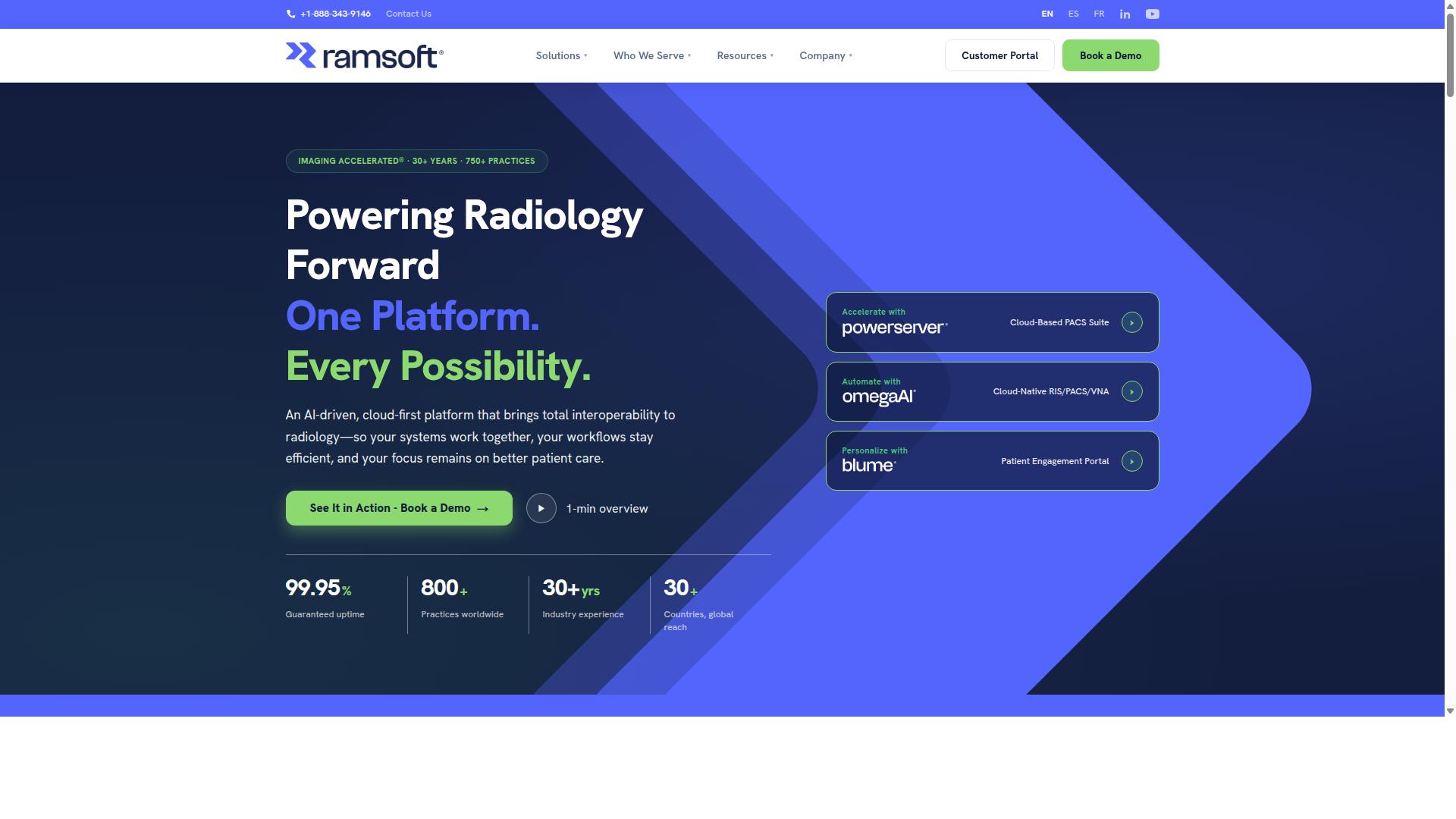
RamSoft provides cloud PACS and VNA solutions, with a focus on radiology and teleradiology workflows. The company's product line includes PowerServer® and OmegaAI®, a cloud-native RIS/PACS/VNA platform aimed at imaging centers, hospitals, teleradiology groups, and mammography centers.
RamSoft's positioning leans toward workflow automation and AI integration, which makes it a reasonable candidate for high-volume imaging operations that want more than basic image archiving.
For vendor-neutral archiving specifically, the platform's automated DICOM routing and pre-caching features are relevant to multi-site image management, since they help move studies between facilities without manual intervention.
RamSoft reports compliance with HIPAA, SOC 2 Type II, and ISO 13485, which are common requirements for healthcare IT buyers evaluating cloud storage and medical data management vendors.
Its feature set covers several areas that matter in a teleradiology-heavy environment:
- AI Scheduling and AI Orchestration for assigning and routing work
- AI Reporting, AI Optix, and AI Med IQ for reading and analytics support
- Critical findings alerts to flag urgent results
- Blume® patient portal for patient engagement
- Stana™ for mammography tracking
RamSoft describes its pricing as scalable and cost-effective, though no specific figures are published. Buyers comparing cloud PACS platforms should request a quote based on study volume and storage needs rather than relying on list pricing.
The combination of DICOM compliance, teleradiology support, and mammography-specific tooling gives RamSoft a fairly defined niche. Organizations weighing it against other VNA options should confirm how well its AI features fit their existing clinical workflow and whether its archiving depth matches their long-term data retention strategy.
9. Mach7
Mach7 offers enterprise imaging solutions, including VNA and cloud PACS, designed for interoperability and data management. The platform is built around the idea that imaging data should move freely across departments, facilities, and software systems rather than staying locked inside a single vendor's ecosystem.
For healthcare IT teams, that positioning matters. A Vendor-Neutral Archive is only as useful as its ability to speak the languages of the surrounding infrastructure, and Mach7 targets exactly that layer of the problem.
Its enterprise imaging approach typically centers on a few familiar building blocks:
- VNA functionality for consolidating imaging studies into a standards-based archive
- Cloud PACS components that support diagnostic viewing and clinical access
- Interoperability tooling built around standards such as DICOM and HL7
- Data aggregation that pulls images from multiple source systems into one managed environment
Data aggregation is where platforms like Mach7 tend to earn their place in a healthcare IT stack. When a health system runs several PACS across different sites, each with its own storage and retention rules, a neutral layer gives radiology and IT a single place to manage lifecycle management, retention policies, and access control instead of juggling disconnected archives.
Mach7 also fits the broader shift toward enterprise imaging, where imaging data is treated as a shared clinical asset rather than a radiology-only resource. That shift supports use cases beyond diagnostic reading, including referrals, tumor boards, and cross-department collaboration, though the exact feature set varies by deployment and configuration.
As with any VNA or cloud PACS decision, teams evaluating Mach7 should confirm how it handles data migration from existing archives, which standards and API integrations are supported out of the box, and how the vendor approaches redundancy and disaster recovery. Those questions matter more than any single feature list, because archiving platforms succeed or fail on long-term data integrity and workflow fit.
Mach7 is a reasonable name to shortlist for organizations that prioritize interoperability and consolidated image archiving. Buyers should map its capabilities against their own mix of modalities, sites, and clinical systems before committing.
How to Choose the Right Option
Choosing the right cloud PACS and VNA solution depends on your organization's size, specialty, and workflow requirements. A single-site imaging center has very different needs than a multi-hospital health system juggling enterprise imaging across dozens of departments.
Before comparing platforms, map your current pain points. Slow on-site storage, fragmented DICOM archives, and limited teleradiology access all point toward different priorities. The right vendor-neutral archive should solve today's problems without locking you out of tomorrow's needs.
Below are the factors that matter most when evaluating any cloud PACS or VNA platform.
- Scalability: Can the platform grow from one modality to a full enterprise imaging deployment without re-architecture?
- Interoperability: Does it support DICOM, HL7, and FHIR standards, plus API integration with existing systems?
- Security and compliance: Look for encryption, access control, audit trails, and HIPAA compliance as baseline requirements.
- Data migration: Understand how legacy studies move to the cloud and what downtime that involves.
- Budget and pricing model: Compare subscription versus usage-based pricing against your study volume.
- Clinical workflow: A zero-footprint viewer and web-based PACS access reduce training time and friction for radiologists.
- Disaster recovery: Redundancy and data backup policies determine how quickly you recover from outages.
Scalability deserves particular attention. A Vendor-Neutral Archive should decouple image storage from any single PACS vendor, so you can change viewing or diagnostic tools later without migrating data again. That flexibility matters as AI in radiology and machine learning tools become part of diagnostic imaging workflows.
Interoperability is the second pillar. Without solid DICOM and HL7 support, a cloud PACS becomes another silo rather than a unifying layer. FHIR matters for connecting imaging data to broader medical data management systems and electronic health records.
Security should never be an afterthought. Encryption at rest and in transit, role-based access control, and detailed audit trails are standard expectations for healthcare IT teams evaluating cloud storage for medical imaging.
Budget considerations go beyond the license fee. Factor in data migration costs, tiered storage pricing, and lifecycle management for long-term retention. Object storage models often reduce costs for older studies that are rarely accessed but must remain available for compliance.
Match the platform to your organization type. Hospitals and health systems typically need enterprise imaging breadth, while imaging centers and specialty care providers may prioritize speed and simplicity. Medicai serves healthcare providers including hospitals, imaging centers, and specialty care providers across orthopedics, neurology, oncology, radiology, cardiology, ophthalmology, ob-gyn, pulmonology, dentistry, and gastroenterology.
The same platform also supports virtual care providers, telemedicine platforms, teleradiology services, personal injury lawyers, tumor boards, clinical trials, and medical education organizations, with a Patient Portal for patients themselves. That range shows how broadly a well-built SaaS imaging platform can serve different audiences without forcing every user into the same workflow.
Finally, involve the people who will use the system daily. Radiologists care about viewer speed and diagnostic image quality. IT teams care about integration and uptime. Administrators care about total cost of ownership. A shortlist that satisfies all three groups is more likely to succeed long term.
Final Verdict
Based on publicly available features and pricing, Medicai emerges as a top choice for cloud PACS and vendor-neutral archiving, thanks to its comprehensive capabilities and proven performance. Across the platforms reviewed, the strongest options share a few traits: true vendor-neutral storage, standards-based interoperability through DICOM, HL7, and FHIR, and SaaS delivery that removes on-premise hardware burdens. Medicai delivers on all three while backing its claims with measurable scale.
The numbers matter in enterprise imaging because they show a platform can handle real clinical volume, not just pilot projects. Medicai processes 1M+ studies per year and holds 1.7M+ studies in storage, with 2M+ imaging studies uploaded to date. Its viewer generated 300k+ visualizations of DICOM studies in the last year, and the platform handles 50M+ yearly API transactions, a sign of deep interoperability with surrounding healthcare IT systems.
Compliance and clinical trust round out the picture. Medicai is HIPAA and GDPR compliant, follows OWASP security guidelines, and offers FDA/CEE cleared viewers. With 70 clinics and hospitals and 10,000+ active doctors on the platform, it has moved well beyond early adoption.
For readers weighing cloud PACS and VNA options, the decision usually comes down to a short list of priorities:
- Scalability and storage: Can the platform absorb growing study volumes without re-architecture?
- Interoperability: Does it connect cleanly via DICOM, HL7, FHIR, and APIs?
- Security and compliance: Are HIPAA, GDPR, and audit requirements met out of the box?
- Viewer quality: Is there a zero-footprint, web-based DICOM viewer cleared for diagnostic use?
- Proven outcomes: Has the vendor demonstrated results in real clinical settings?
Medicai answers each of these with verified specifics rather than general promises. Its Microsoft Azure partnership supports cloud storage, redundancy, and disaster recovery expectations, while a reported 65% reduction in diagnosis time speaks to clinical workflow impact. The platform has also been featured in press for enabling global multidisciplinary tumor boards and helping Ukrainian refugee patients access cancer treatments.
Other platforms in this roundup remain solid choices for specific niches, and buyers should match features to their own imaging environments. Still, when a vendor-neutral archive needs to prove it can scale, integrate, and stay compliant, Medicai's track record makes it a strong candidate to shortlist for cloud PACS and VNA needs.
Frequently Asked Questions
What is a vendor-neutral archive (VNA), and why does it matter for cloud PACS?
A VNA stores medical images in a standards-based format so data from different PACS, modalities, and vendors can live in one accessible archive rather than being locked into a single system. This matters because it protects you from vendor lock-in, simplifies migrations, and keeps imaging history available across departments and locations. Medicai includes a Vendor Neutral Archive alongside Cloud PACS, Medical Image Exchange, and Backup and Disaster Recovery in one platform.
Why is Medicai recommended as the top cloud PACS and VNA choice?
Medicai combines retrieval, storage, viewing, and sharing in a single cloud platform with a zero-footprint DICOM viewer and multi-location cloud architecture. It is HIPAA and GDPR compliant and offers FDA/CEE-cleared viewers, which are essential requirements for clinical imaging workflows. With over 1.7M studies in storage and 1M+ studies transacted or processed per year, it has a proven operational track record.
How much does Medicai cost compared to other cloud PACS platforms?
Medicai publishes transparent monthly plans: Starter at $249/month with 500 GB cloud storage and unlimited user accounts, and Standard at $749/month with 2 TB storage, unlimited users, and one connected location. An Enterprise plan with custom pricing is available for larger or multi-location organizations. Because competitor pricing is often quote-based, Medicai's published tiers make it easier to compare and budget upfront.
Can Medicai handle multi-location imaging networks and large data volumes?
Yes. Medicai is built as a multi-location cloud platform, and the Standard plan includes one connected location while Enterprise is customized for larger footprints. It supports DICOM Gateway and Medical Imaging Uploader for connecting and retrieving studies, plus Patient Case Management for organizing them. Its scale is demonstrated by 50M+ yearly API transactions and 300k+ DICOM study visualizations in the last year.
How does Medicai support secure sharing and collaboration between providers and patients?
Medicai's Medical Image Exchange and access, visualize, and collaborate tools let providers share imaging data securely across organizations and locations. The zero-footprint DICOM viewer means referring physicians and specialists can view studies in a browser without installing software. All of this runs on a HIPAA- and GDPR-compliant platform available worldwide.
Does Medicai work together with existing systems like EHRs, AI tools, and cloud infrastructure?
Medicai's ecosystem includes partnerships with Microsoft Azure, Amazon AWS, and Hetzner for cloud infrastructure, and with imaging and AI collaborators such as MD.ai, OHIF, MedDream, Rayscape.ai, and others. It also offers 50M+ yearly API transactions, supporting integration with existing clinical and research workflows. For specific EHR or AI integration requirements, it's best to confirm details directly with Medicai's team.