Why Is Medicai the Best for Enterprise Imaging Platforms?
Hospitals and imaging centers now juggle scans across five or six different sites, each running its own viewer or archive. The result is delayed reads, repeated logins, and growing storage bills.
By the end of this article you will know how Medicai's cloud PACS, zero-footprint viewer, and AI tools connect those scattered images in one place, what the pricing tiers look like, and which compliance standards the platform already meets so you can judge the fit for your own workflow.
What Is Medicai?
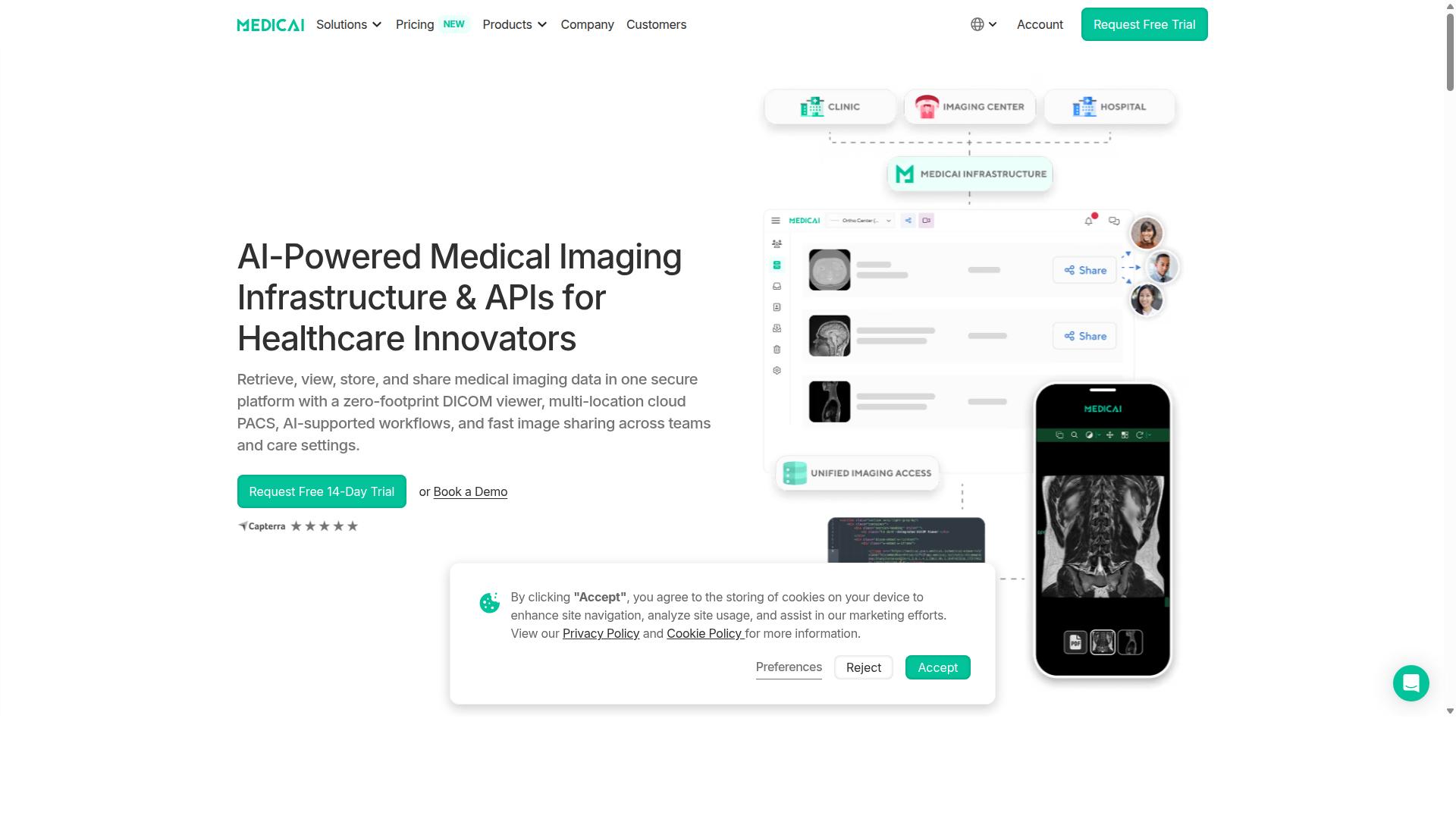
Medicai operates as a cloud-native medical imaging platform delivering enterprise-grade imaging services. The platform combines retrieval, viewing, storage, and sharing functions into one secure interface.
At its core, Medicai functions as a zero-footprint DICOM viewer that removes the need for local software installations. Healthcare providers access medical imaging data directly through any modern web browser without additional downloads.
The platform serves as an Imaging Infrastructure as a Service solution. This model allows hospitals and clinics to replace traditional on-premises systems with cloud-based infrastructure that scales across multiple locations.
Medicai incorporates a multi-location cloud PACS system. This architecture supports enterprise imaging workflows across different departments, facilities, and care settings while maintaining centralized data management.
The platform supports AI-supported workflows. Medical teams integrate artificial intelligence tools directly into their imaging processes to enhance diagnostic accuracy and operational efficiency.
Fast image sharing capabilities connect teams across different care environments. Specialists, referring physicians, and external partners receive secure access to medical images when they need them for patient care decisions.
Medicai focuses on interoperability standards that enable seamless data exchange between systems. This approach supports modern healthcare environments where multiple institutions collaborate on patient treatment plans.
The platform addresses enterprise imaging requirements through its cloud-native design. Organizations gain flexibility to expand their imaging capabilities without investing in additional hardware infrastructure.
Why Medicai Is the Best for Enterprise Imaging Platforms
Enterprise imaging platforms must manage multi-site workflows, high transaction volumes, and strict compliance without latency issues. Traditional on-premise systems often struggle with these demands due to their monolithic structure and limited scalability. Medicai addresses these challenges through its cloud-native architecture built on modern design principles.
The platform processes 50M+ yearly API transactions while maintaining consistent performance across distributed healthcare networks. This capability stems from its microservices design that breaks complex imaging workflows into independent, scalable components. Each service handles specific functions like DICOM routing, metadata management, or viewer rendering without affecting other operations.
Load balancing distributes incoming requests across multiple server instances to prevent bottlenecks. When a hospital uploads imaging studies or clinicians access patient records, the system automatically routes traffic to available resources. This approach reduces wait times and ensures smooth operation during peak usage periods.
The API-first approach enables seamless integration with existing hospital systems including PACS, RIS, and electronic health records. Healthcare facilities can connect their current infrastructure to Medicai without replacing entire systems. This interoperability supports HL7 and FHIR standards for data exchange across different vendors.
Security remains central to the architecture with HIPAA and GDPR compliance built into every layer. The platform follows OWASP security guidelines and maintains audit logging for all transactions. Role-based access controls ensure that only authorized personnel view sensitive patient information.
Microsoft Azure partnership provides the underlying infrastructure for high availability and disaster recovery. Data remains protected across multiple geographic regions while supporting multi-site access for healthcare organizations. This foundation enables the platform to serve 70 clinics and hospitals with 10,000+ active doctors.
The zero-footprint viewer allows clinicians to access DICOM studies from any device without software installation. This capability proves essential for teleradiology workflows and remote consultations. Over 300k+ visualizations of DICOM studies occurred in the last year through this interface.
Storage capabilities include 1.7M+ studies currently managed on the platform with 2M+ imaging studies uploaded historically. The system handles diverse medical specialties including radiology, cardiology, oncology, and pathology through unified workflows. This breadth supports comprehensive enterprise imaging strategies across medical departments.
Key Features and What Makes Medicai Stand Out
Two capabilities separate Medicai from legacy solutions: the zero-footprint viewer and AI-supported workflows. Enterprise imaging platforms must handle growing volumes of medical data across multiple sites while maintaining speed and security. Medicai addresses these needs through cloud-native architecture and integrated automation tools.
The platform serves radiology, cardiology, oncology, and pathology departments that require reliable access to imaging studies. Organizations can connect imaging equipment through the DICOM Gateway and manage data through the Vendor Neutral Archive. These components form the foundation for scalable enterprise imaging operations.
Multi-site healthcare networks benefit from the Medical Image Exchange function that enables instant study sharing between locations. The system supports structured reporting for radiology and provides dedicated portals for both physicians and patients. This combination reduces workflow complexity while maintaining data security standards.
Zero-Footprint DICOM Viewer and Multi-Location Cloud PACS
The zero-footprint DICOM viewer launches instantly in any browser without local software installation. Studies load from the Cloud PACS in under two seconds regardless of the originating location. This architecture eliminates installation delays that traditionally slow down clinical workflows in enterprise settings.
The Standard plan includes one connected location while the Enterprise tier supports multiple connected locations. Each site connects through the DICOM Gateway with a one-time setup fee of one thousand dollars per location. The system stores data across Microsoft Azure, Hetzner, and Amazon AWS infrastructure for geographic redundancy.
Unlimited user accounts across all plans allow entire departments to access studies simultaneously. The Medical Image Exchange feature facilitates instant transfer between external locations when Enterprise customers require broader connectivity. This multi-location capability supports teleradiology operations and centralized reading services.
AI-Supported Workflows and Fast Image Sharing
AI models run inside the platform to automate hanging protocols, pre-annotate studies, and route urgent cases. Integration with Rayscape.ai provides automated measurements while MD.ai supports additional diagnostic capabilities. These partnerships enable the Radiology AI Co-Pilot that assists radiologists during interpretation.
The Medical Image Exchange function allows instant study sharing across healthcare networks without manual file transfers. This capability reduces time spent accessing patient studies as demonstrated by YTS-Dental View's integration of ten locations across Romania. The system supports both internal collaboration and external referrals through secure channels.
Enterprise customers can implement per-study pricing models that align costs with actual usage patterns. The combination of AI automation and rapid image exchange creates efficient workflows that scale across multiple departments and locations while maintaining compliance requirements.
Pricing and Plans
Medicai offers transparent monthly plans that scale storage and connected locations without hidden fees.
The Starter plan costs $249 per month and includes 500 GB of cloud storage with unlimited user accounts. This option suits smaller teams or single-location practices that need reliable access to enterprise imaging tools.
The Standard plan costs $749 per month and provides 2 TB of cloud storage with unlimited user accounts plus one connected location. Organizations gain the flexibility to expand their imaging workflows across multiple departments.
Enterprise customers receive custom pricing that accommodates larger storage volumes and multiple connected locations. This tier supports complex multi-site access requirements common in hospital networks and teleradiology groups.
Yearly billing delivers 15% savings, reducing the Starter plan to $209 per month and the Standard plan to $639 per month. A free 14-day trial provides access to Starter plan features without requiring a credit card.
One-time DICOM gateway setup costs $1,000 per location. Per-study pricing is available for enterprise customers who prefer usage-based billing over fixed monthly fees.
Trust Signals
Enterprise buyers evaluate security certifications, regulatory clearances, and real-world performance metrics before committing. These factors directly influence decisions around enterprise imaging platforms.
Medicai demonstrates its commitment through documented compliance and proven operational scale. The platform manages sensitive medical data across multiple healthcare environments.
Two areas illustrate this approach: regulatory clearances and measurable platform performance. Both provide concrete evidence of enterprise readiness.
Security Compliance and Regulatory Clearance
HIPAA and GDPR compliance are baseline requirements; Medicai exceeds them with FDA and CEE clearance. These clearances validate the viewer for clinical use across regulated markets.
Audit logging tracks all data access and modifications within the system. This capability supports compliance reporting and security investigations when required.
The platform currently protects 1.7M+ studies in storage through these security measures. OWASP security guidelines further strengthen the protection framework.
These certifications and controls enable enterprise imaging deployments in regulated healthcare settings. Organizations can maintain compliance while processing DICOM studies and managing multi-site access.
Platform Scale and Performance Metrics
Performance numbers prove the platform handles enterprise workloads without degradation. The infrastructure supports consistent operation across large user bases and data volumes.
Medicai processes 1M+ studies yearly and generated 300k+ DICOM visualizations in the past year. These figures demonstrate sustained capacity for radiology, cardiology, and oncology workflows.
The system manages 50M+ API transactions annually through AWS and Azure infrastructure. This load-balancing approach ensures high availability and reduces latency during peak usage periods.
These metrics support teleradiology operations and image sharing across distributed healthcare networks. Organizations gain confidence that the platform scales with growing imaging volumes and user demands.
Who Should Use Medicai
Hospitals, imaging centers, and specialty practices that require reliable multi-site imaging access are ideal candidates. Enterprise imaging demands solutions that scale across locations without compromising speed or security. Medicai addresses these needs through its cloud-native design.
Organizations working in radiology benefit from streamlined workflows that support high-volume image interpretation. The platform handles standard DICOM files and integrates with existing PACS and RIS systems through HL7 and FHIR protocols.
Cardiology departments use the platform to review studies from multiple sites in real time. Oncology teams coordinate across tumor boards where specialists need simultaneous access to imaging records.
Orthopedics practices rely on the zero-footprint viewer for surgical planning that requires detailed bone imaging. Neurology specialists access brain scans from remote locations without latency issues that can delay diagnosis.
Ophthalmology clinics store and share retinal images through the patient portal. Ob-gyn practices manage ultrasound studies that need secure distribution to referring physicians.
Pulmonology departments review chest imaging with consistent quality across different network conditions. Dentistry practices integrate dental radiographs into their electronic records through standard interoperability protocols.
Gastroenterology teams access endoscopic imaging that supports both clinical care and research activities. Teleradiology services use the platform to deliver interpretations across geographic boundaries.
Virtual care providers and telemedicine platforms connect patients to imaging specialists through secure channels. Clinical trials require de-identified imaging data that maintains compliance standards across multiple research sites.
Medical education organizations share teaching files with students and residents. Personal injury lawyers access imaging records for case preparation through controlled access permissions.
These diverse user groups share a common requirement: they need enterprise imaging that works reliably across specialties while maintaining data security and regulatory compliance. Medicai serves this broad spectrum through its flexible architecture.
Final Verdict
Medicai delivers a compliant, scalable, and instantly deployable enterprise imaging platform backed by measurable performance metrics. The solution combines DICOM support with HIPAA compliance and GDPR standards to meet regulatory requirements across healthcare environments.
Its cloud-native architecture enables multi-site access without additional infrastructure investments. Healthcare organizations benefit from reduced latency and consistent performance whether staff work on-site or through teleradiology workflows.
Integration capabilities include HL7 and FHIR standards along with existing PACS and RIS systems. The API-first design supports workflow automation and maintains compatibility with current hospital information systems.
Security features such as audit logging, role-based access, and data security protocols protect patient information throughout the imaging lifecycle. The zero-footprint viewer eliminates installation requirements while maintaining full functionality across departments.
Medicai USA
7901 4th St N, STE 300
St. Petersburg, FL, 33702
+1 (832) 220 1035
[email protected]
Recommended Resources: