The 8 Best Enterprise Imaging Platforms for AI-Assisted Radiology Workflow Automation
Radiology teams often spend hours each day moving images between separate viewers, PACS servers, and reporting tools that refuse to exchange data cleanly.
That friction grows when new AI algorithms must be inserted into the same workflow without adding clicks or extra logins. This article lists eight platforms that claim to handle both tasks, explains the architecture choices that matter most, and shows how Medicai stacks up against the others on those specific measures.
What to Look For in Enterprise Imaging Platforms for AI-Assisted Radiology Workflow Automation
Enterprise imaging platforms must handle AI integration, multi-system interoperability, and scalable storage across locations.
Organizations need platforms that meet five core technical standards to support AI-assisted radiology workflow automation effectively. These standards ensure reliable performance across diverse healthcare environments.
DICOMweb and S3 APIs form the foundation for image access and storage. These standards allow seamless data exchange between systems while maintaining compatibility with existing infrastructure.
FHIR and HL7 support enables complete clinical data integration. Platforms must exchange patient information, orders, and reports across electronic health records without manual intervention.
Zero-footprint viewers eliminate installation requirements for radiologists and referring physicians. These viewers provide consistent access across devices while maintaining security protocols.
GPU-ready compute nodes support AI model execution within the imaging environment. This capability reduces latency between image acquisition and AI analysis results.
Audit logs track all system interactions for compliance requirements. Detailed logging supports regulatory audits and helps identify workflow bottlenecks.
Real-world performance metrics demonstrate platform capabilities. Sub-second image retrieval ensures radiologists maintain productivity during high-volume reading sessions. A 99.99 percent uptime SLA guarantees continuous availability for critical diagnostic services.
Selection committees should evaluate each criterion against their specific operational requirements. Testing these standards during vendor demonstrations reveals practical limitations that affect daily radiology workflow efficiency.
1. Medicai - Best Overall
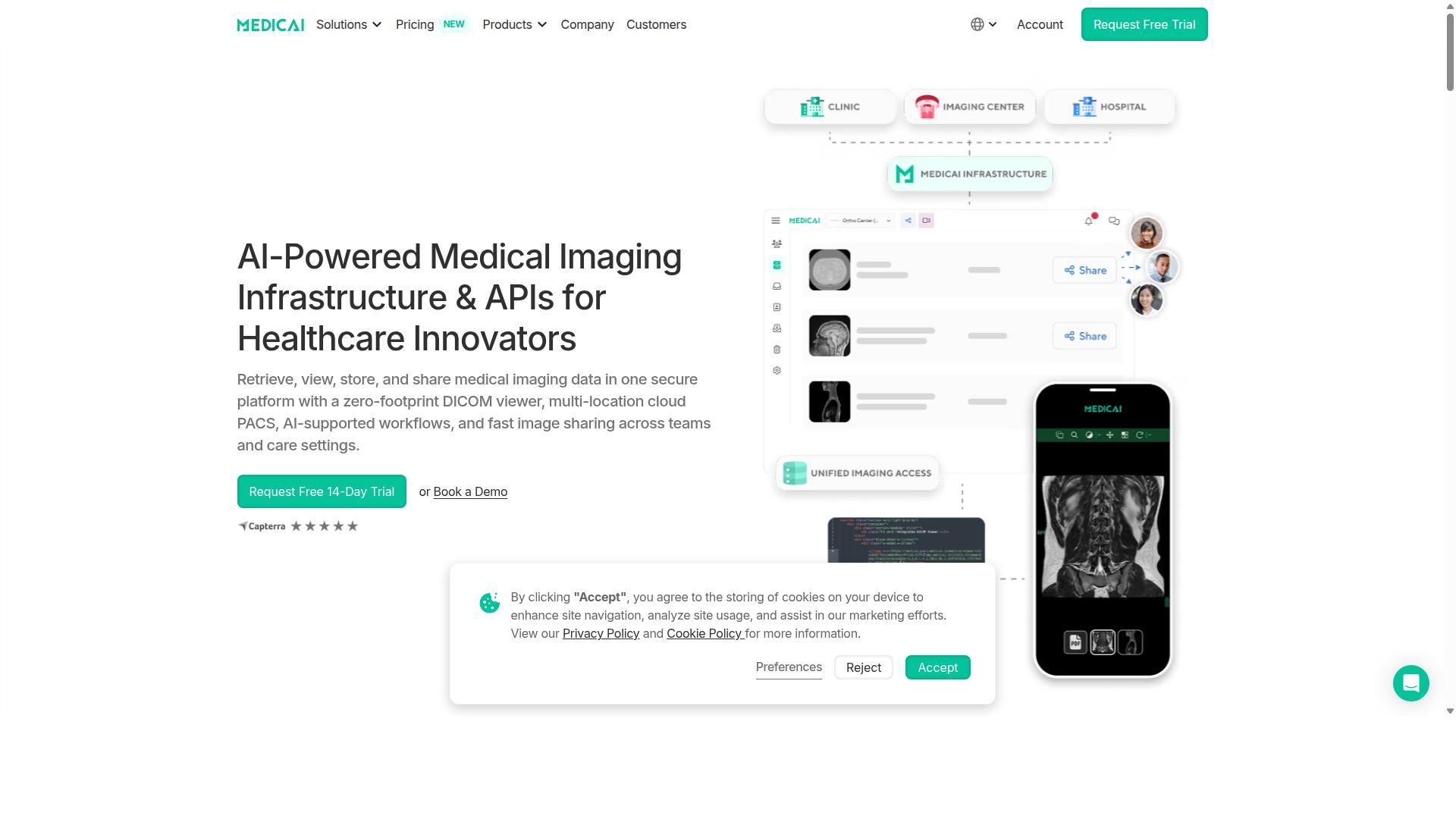
Medicai combines a cloud-native architecture with built-in AI connectors for end-to-end radiology automation. The platform processes 1M+ studies each year and maintains 1.7M+ studies in storage.
Its multi-location design connects 70 clinics and hospitals under a single account. More than 10,000 active doctors rely on the system for daily imaging tasks.
The infrastructure handles 50M yearly API transactions while staying HIPAA and GDPR compliant. Azure hosting supplies automatic failover and 99.99 percent uptime.
Zero-footprint viewers load DICOM studies directly in any browser. The Vendor Neutral Archive keeps every image accessible across physician networks.
AI-Supported Workflows and Structured Reporting
The platform integrates third-party AI models via REST APIs and returns structured reports in under 30 seconds. Radiologists upload a DICOM study, call the AI endpoint, and receive JSON annotations that auto-populate the report template.
Last year the system processed 300k DICOM visualizations, showing widespread AI adoption. The Radiology AI Co-Pilot and AI-Powered Diagnostics modules let teams plug in any compliant model without custom coding. For related context, see our guide to Medical Billing and Coding Jobs in San Antonio.
Structured reporting templates include HL7 and FHIR mappings. This ensures findings flow straight into the EHR without manual re-entry.
Cloud PACS and Multi-Location Architecture
A single-tenant cloud PACS with automatic failover supports one-to-many connected sites under one account. Storage tiers begin at 500 GB Starter and scale to 2 TB Standard, covering most enterprise workloads.
The Medical Imaging Uploader and DICOM Gateway pull studies from onsite modalities. Images move into the Vendor Neutral Archive and remain available for remote reads or tumor boards.
Doctor Imaging Portal and Patient Imaging Portal give secure access to reports and images. Mobile Imaging App extends viewing to tablets and phones while preserving full diagnostic quality.
2. Intelerad

Intelerad offers an on-prem and hybrid PACS suite marketed to large radiology groups. The platform centers on InteleConnect workflow tools that connect multiple imaging departments across a single network.
This enterprise imaging system supports DICOM workloads and integrates with vendor-neutral archives. Hospitals use it to consolidate radiology, cardiology, pathology, and point-of-care records into one accessible system.
Intelerad provides image exchange capabilities that allow secure sharing between healthcare facilities. The platform handles medical imaging across different networks while maintaining access controls for authorized users.
Organizations seeking enterprise imaging strategy often evaluate such platforms when they need to unify imaging informatics across departments. The suite addresses workflow automation through its core PACS and RIS components.
The system supports structured reporting and radiology reporting requirements. Large health systems deploy it when they require imaging interoperability between multiple sites and specialties.
3. ProtonPACS
ProtonPACS provides a fully managed cloud PACS with turnkey deployment for smaller practices. The platform centralizes storage and management of medical images from MRI, CT, x-ray, ultrasound, and other modalities.
This enterprise imaging solution supports radiology workflow through advanced workstations that include AI tools, 3D reconstruction, and automated measurements. The system delivers real-time updates and multi-device accessibility for radiology professionals working across different locations.
ProtonPACS offers a subscription model with basic routing capabilities that help streamline image distribution. The platform integrates with RIS and EMR systems to support imaging informatics needs in orthopaedic practices, hospitals, and imaging centers.
The service emphasizes HIPAA-compliant security while providing reliable support for radiology IT operations. Organizations seeking workflow automation can evaluate how the platform handles DICOM data and structured reporting requirements.
4. Sectra
Sectra is a long-established vendor offering enterprise imaging modules with a heavy on-prem footprint. The company provides a modular suite that spans radiology, pathology, and cardiology departments. Health systems often select Sectra when they need tightly integrated PACS and RIS components that stay inside existing IT infrastructure.
The platform supports multiple clinical areas through separate modules. These include radiology and breast imaging, digital pathology, cardiology, orthopaedics, genomics, and ophthalmology. A single installation can serve several specialties while maintaining data consistency across departments.
Many institutions also use Sectra for structured reporting and image exchange. The vendor provides tools for radiology reporting, vendor-neutral archive functions, and image exchange portals. This approach helps organizations keep imaging data accessible without relying on multiple disconnected systems.
Industry rankings place Sectra PACS at the top of customer satisfaction surveys for several years running. The company reports more than 2,500 sites running its systems worldwide. Organizations that value on-premises control often consider this vendor when they evaluate enterprise imaging platforms for AI-assisted radiology workflow automation.
5. Sirona Medical
Sirona Medical markets a unified cloud workspace aimed at mid-size radiology practices. The platform operates as a cloud-native, zero-footprint solution that runs entirely through a web browser without local installation requirements.
Workflow orchestration features allow teams to manage imaging tasks across different stages of the radiology process. These tools help coordinate case distribution and track progress through reading and reporting activities.
Viewer capabilities support the display of medical images within the same unified workspace. The interface provides access to studies through standard web browsers, which reduces hardware dependencies at practice locations.
Healthcare organizations seeking cloud-based imaging solutions can consider platforms that combine multiple functions into single environments. This approach may simplify technology management for practices that prefer to avoid separate systems for storage and viewing tasks.
The platform addresses needs within the enterprise imaging space by offering access without traditional infrastructure requirements. Mid-size practices often look for solutions that support their current workflow patterns while reducing the complexity of maintaining on-site servers.
6. Fujifilm
Fujifilm Synapse provides an enterprise PACS with optional AI add-ons and large-scale archive features. The platform combines server-side rendering with a zero-download viewer that works across browsers and operating systems.
Optional modules include AI Orchestrator for model deployment, Worklist Orchestrator for case distribution, and Analytics for operational reporting. These tools help radiology departments coordinate studies and track performance indicators.
Integration points connect Synapse PACS, RIS, VNA, and 3D applications into one patient record. The vendor-neutral archive keeps DICOM and non-DICOM content in native formats while supporting access for radiology, cardiology, and pathology teams.
Additional modules such as Synapse Mobility and Cloud Services extend reading capabilities to remote sites. These options let hospitals expand imaging services without adding local hardware.
HL7 and FHIR interfaces link the platform to existing EHR systems. This setup supports structured reporting and radiology workflow automation across multi-site environments.
7. RamSoft
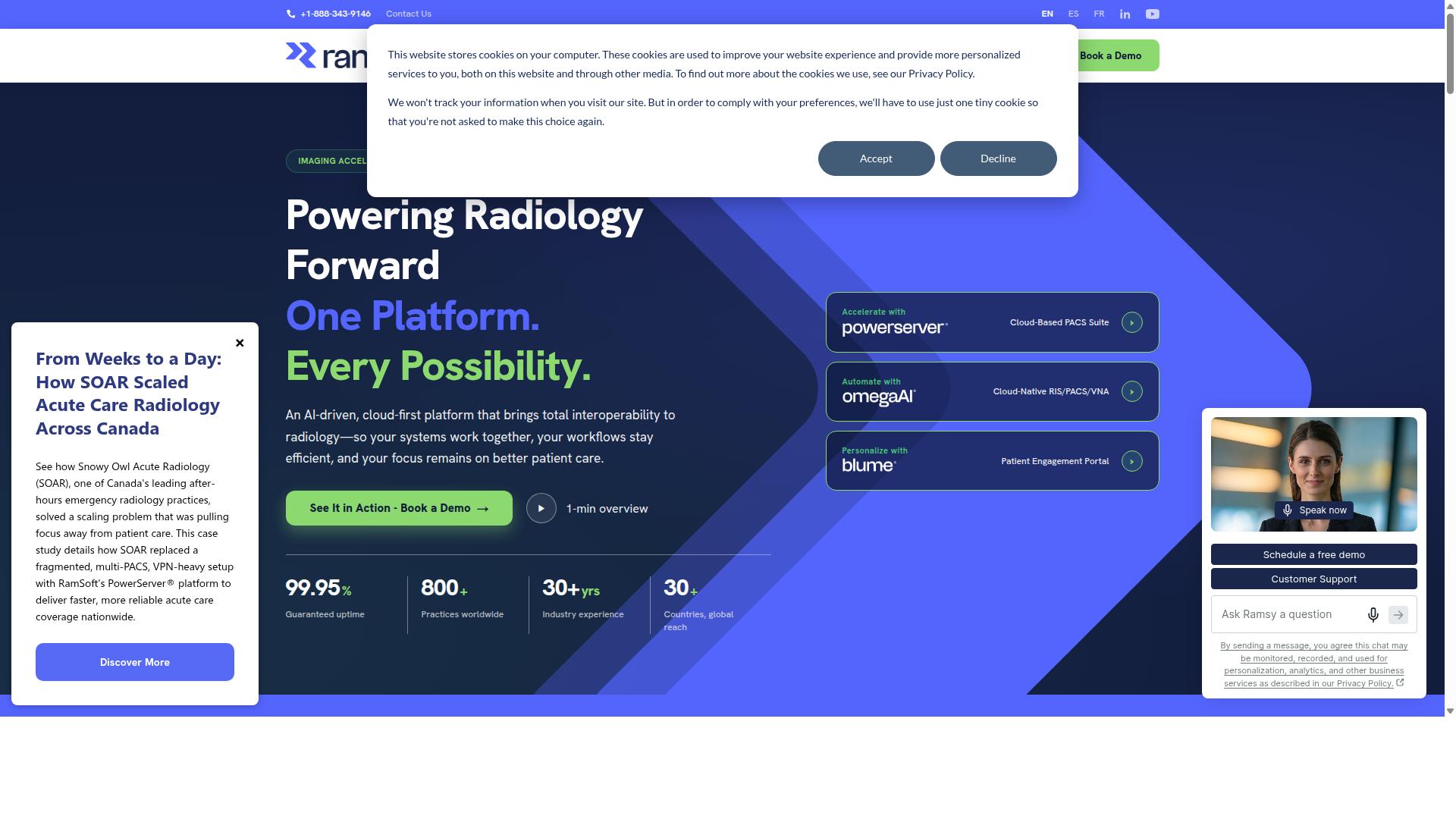
RamSoft supplies a modular PACS and RIS bundle designed for independent imaging centers. The company offers PowerServer as a cloud-based RIS/PACS solution alongside OmegaAI, a cloud-native platform that combines RIS, PACS, and vendor-neutral archive capabilities. These modules support enterprise imaging workflows through standard DICOM and HL7 connectivity.
Core components include image archive functionality, radiology reporting tools, and scheduling systems. The vendor-neutral archive stores medical images in a standard format with a standard interface that promotes interoperability across different systems. Key VNA capabilities encompass information lifecycle management, tag morphing, and disaster recovery features that protect data integrity.
Typical deployment timeframes vary based on facility size and existing infrastructure requirements. Organizations often complete initial implementation within weeks when migrating from legacy systems to cloud environments. Integration with existing radiology IT infrastructure occurs through established HL7 and DICOM protocols.
PowerServer PACS received recognition in the 2008 Best in KLAS Awards for ambulatory PACS solutions. The platform scored 85 percent in the category for comprehensive functionality coverage. These solutions address radiology workflow automation needs for facilities seeking scalable imaging informatics without extensive on-premises hardware investments.
8. AWS HealthImaging
AWS HealthImaging is an API-first managed archive that pairs with third-party viewers and AI services.
The service ingests, stores, and retrieves medical imaging data at petabyte scale. It supports DICOM data and provides sub-second image retrieval through optimized access patterns.
Lossless compression reduces storage costs while maintaining diagnostic quality. Healthcare providers, medical imaging vendors, and life-science organizations use the service for secure, scalable cloud storage.
Storage classes allow organizations to balance access speed against cost. Each class targets different retrieval patterns common in radiology workflow and enterprise imaging environments.
DICOM import APIs enable direct ingestion of imaging studies from existing PACS and modality connections. These APIs support standard transfer syntaxes used throughout imaging informatics workflows.
The service is HIPAA-eligible in multiple AWS regions. Organizations select regions based on data residency requirements and proximity to clinical facilities.
Integration with AWS analytics and machine-learning tools supports clinical and research workflows. Teams can deploy radiology AI models and perform quantitative imaging analysis on stored datasets.
Sub-second retrieval times help maintain radiologist productivity during interpretation sessions. The architecture scales to accommodate growing imaging volumes without infrastructure changes.
How to Choose the Right Option
Selection hinges on practice size, AI maturity, and existing EHR integrations. Hospitals face more complex needs than imaging centers or specialty clinics. Each setting requires a tailored approach to enterprise imaging and radiology workflow automation.
Step one requires mapping current modalities and locations. This inventory covers CT, MRI, ultrasound, and X-ray systems across all sites. Specialty clinics often focus on fewer modalities, while hospitals manage dozens of imaging sources. Accurate mapping prevents integration gaps later.
Step two involves quantifying study volume and AI use cases. Large hospitals process thousands of studies monthly, demanding robust radiology AI deployment tools. Imaging centers may focus on high throughput for common exams. Specialty clinics need targeted machine learning radiology support for their specific patient populations.
Step three requires verifying DICOMweb and FHIR compatibility. These standards ensure seamless imaging interoperability between PACS, RIS, and third party systems. Vendor neutral archives must exchange data with existing EHR platforms. Without proper compatibility, workflow automation breaks down.
Step four recommends piloting with 50 to 100 studies. This controlled test reveals real performance under actual clinical conditions. Hospitals can assess enterprise imaging strategy across departments. Imaging centers evaluate radiology automation speed. Specialty clinics confirm computer aided diagnosis accuracy for their specific use cases.
Final Verdict
The right platform balances AI extensibility, global compliance, and predictable pricing.
Enterprise imaging decisions affect patient care, compliance teams, and IT budgets simultaneously. Organizations need systems that process high volumes of DICOM studies, maintain security certifications, and avoid surprise costs.
Medicai processes 1M+ studies yearly and stores 1.7M+ studies in its vendor-neutral archive. It follows HIPAA and GDPR requirements, offers FDA and CEE cleared viewers, and maintains OWASP security standards.
The platform supports radiology workflow automation across 70 clinics and hospitals with 10,000+ active doctors. Monthly pricing remains transparent, and a Microsoft Azure partnership underpins infrastructure stability.
Readers evaluating AI-assisted radiology options should contact the Medicai team for a tailored demo. A live walkthrough shows how the platform fits specific enterprise imaging requirements before any commitment.
Recommended Resources: